


Every book I have written is $10 this week, down from $60.
Yeah, I know, exactly the kind of email you were expecting this Friday, huh?
So let me spend most of this post on the part those emails usually skip, which is what you would actually be getting. Five books, three of them I am actively working on and two of them I have not touched in a long time, but will pretty soon.
The three books in active work
Mostly Harmless AI is the finished one. Second edition, 305 pages, sixteen chapters across foundations, applications and dangers, with a glossary of 515 cross-linked entries. No code or math, just intuitions. It is the book I hand people who ask what AI actually is and want an answer from someone neither selling it nor afraid of it. But finished does not mean permanent: any version of this book is wrong about some specific thing within six months, which is why a new edition ships roughly every semester, and you get all of them forever.
The Algorithm Codex is the most technical of the lot. Thirty-eight chapters, 476 pages, every algorithm written as runnable, type-checked Python instead of pseudocode nobody can execute. If a code block in it is wrong, the book does not build. But it is five parts of a planned eight. That’s a whole second volume scheduled for early next week.
The Science of Computation is the roughest one, and by far my favorite. It has twenty-six chapters, 268 pages, about a hundred thousand words, complete in first draft: the whole field of computer science in one arc, from computability to large language models, with no mathematics or code. But it is nowhere near done. I’d say maybe 60% in, so expect several updates over the next few months.
And the two books I have neglected for some time
The Hitchhiker’s Guide to Graphs has not moved since 2024. How to Train your Chatbot I tore down and restarted from scratch, and the rewrite is early. Both get real work before the end of the year, pinky promise. And when they do, every version lands in your library at no extra cost. That is the whole point of buying early.
And what the heck is Hopper Week?
On September 9, 1947, a team working on the Harvard Mark II pulled a moth out of a relay and taped it into the logbook. Underneath it, someone wrote: “First actual case of bug being found.” You have probably seen the photograph.
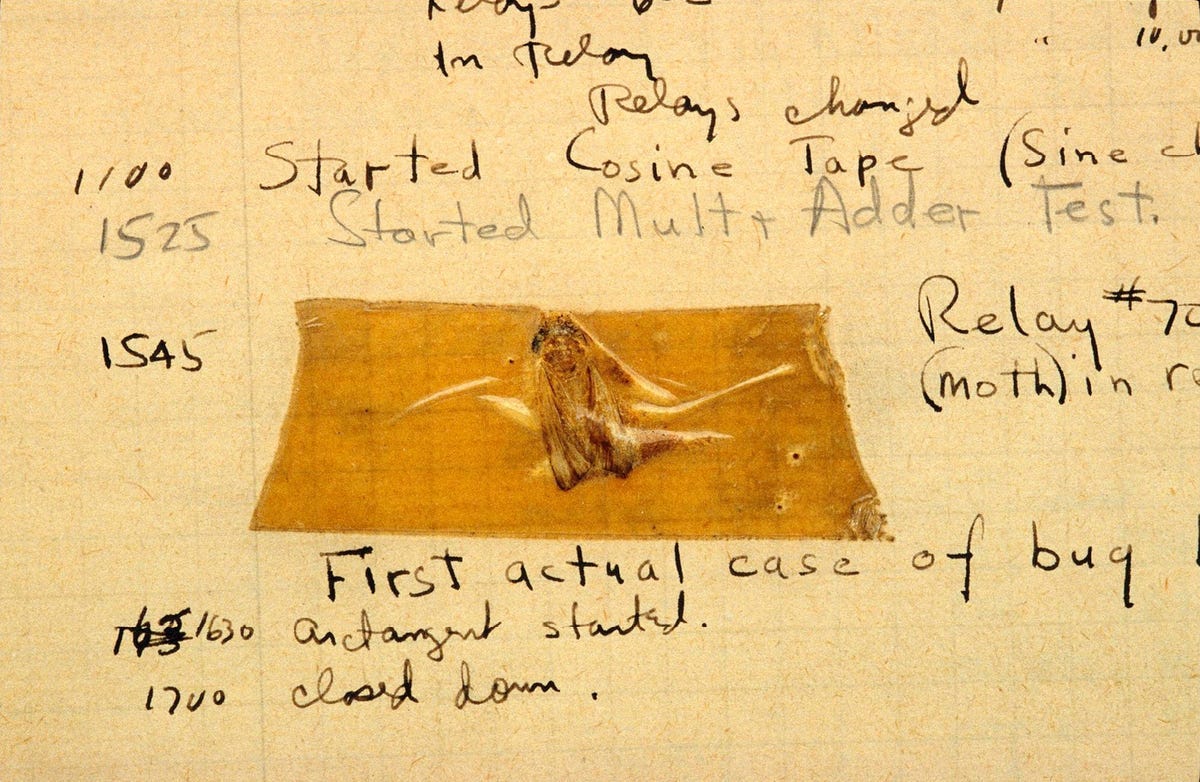
But I think most people miss why it is funny. Bug already meant a fault. Engineers had used the word that way for decades, and Edison was complaining about bugs in his inventions back in the 1870s. So the joke is not that they found a new phenomenon and named it. The joke is that for once the damn thing was an actual insect.
Grace Hopper was on that team, but that is the least interesting thing she did.
In 1952 she built the A-0, one of the first working compilers, on a premise nobody liked: that you should describe a computation once, in something closer to how a person thinks, and let the machine translate it down to whatever hardware was in the room that year. Everyone knew computers did arithmetic, and you spoke to them in their terms, and you were grateful.
But Hopper thought that had it backwards. The machine is the party with infinite patience, so make it do the translating. She was told this was a waste of time. She turned out to be right about all of it.
So I did not plan these books as variations on one theme. It turned out to be one anyway. Where does the machine stop and the meaning start.
The offer, again
Celebrating the first ever computer bug. Ten dollars for all my books, until Friday, September 18.
By the way, The Algorithm Codex is also new to the Compendium as of today. If you already bought the bundle, it is in your library and you owe me nothing. Same as the unfinished Codex parts and the repairs to The Science of Computation when they land.
And if ten dollars is genuinely not available to you right now, email me and I will send you the full PDFs. No explanation required. I would much rather you read the thing than not read it over a price, and that offer has no deadline.
Thanks for reading, and for putting up with the sales pitch.