


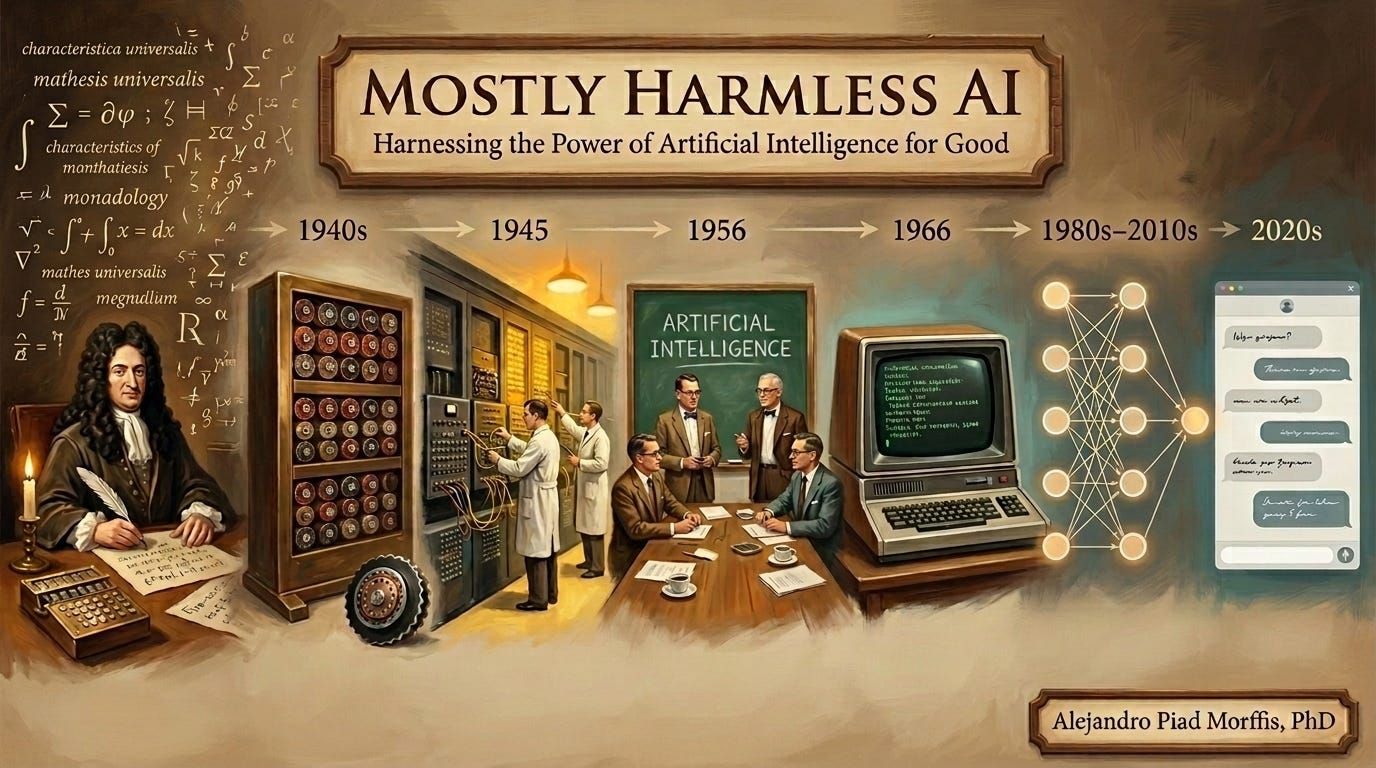
This week I’m pushing towards a sane v2.0 version of Mostly Harmless AI, the book that shows you what AI is, what you can do with it, and where it can go wrong, without the hype or the bullshit. I mean “sane” because “done” is unreachable, this fields moves just too fast. So I’ll aim for something that is good enough for today’s reality, and revisit it in six months when we I have more to say—as I’m sure I will.
This is a quick recap of what’s changing from version 1.0 and how to get it. The first draft went out Friday. Since then I have been working through the rough edges, the kind you can only see once the whole book is in front of you at once. The version on the site today is materially better than what shipped on Friday.
The two main changes since Friday
The prologue is properly a prologue now.
When you open the prologue now, it begins where the idea began. The first edition opened in the 1950s, where the field opened. That was a mistake. The ideas that made modern AI possible were not born at Dartmouth in 1956 — they were assembled over three hundred years, by people who had no computers and no reason to suspect their work would one day converge into one. The new version begins with Leibniz in the 1670s, who imagined a calculus ratiocinator that could reduce human reasoning to calculation; with Ada Lovelace in the 1840s, who saw that symbols could represent anything, not just numbers; and with Alan Turing in 1936, who drew the boundary of what computation could do as a mathematical object, decades before the first computer existed. The rest of the prologue walks the seventy years between that theoretical foundation and the moment the field became an industry. The chronology now starts where the idea did, not where the field did.
There’s a glossary now.
The glossary for Mostly Harmless AI covers 484 entries — every person, system, technique, and field-of-art term used anywhere in the body. That includes Backpropagation, AlphaFold, the Bombe, ELIZA, RLHF, Stochastic Parrots, the Lighthill Report, and several hundred more. Each entry links bidirectionally: click a term in a chapter to jump to its definition; click a back-reference in the glossary to jump to where the term was used. When a term keeps recurring across chapters, the back-references show you the through-line. You can read the book without bringing any specific prior vocabulary.
I rewrote the preface in the same voice as the chapters — shorter, sharper, without the prompt-engineering rubble from the first AI-assisted cut. The cover is new too: a painterly collage running from Leibniz through Bletchley Park, ENIAC, Dartmouth, ELIZA, the multilayer perceptron, and the chatbot. Babbage was on the original cover and shouldn’t have been. He belongs in Lovelace’s chapter, and that’s where he is now.
Here is what the access model looks like and what your support funds, if you choose to give it.
Access and support
Mostly Harmless AI is free to read in perpetuity at books.apiad.net. The reader there has clean typography, dark mode, and inline footnotes — no popups, no tracking, no required signup. Not a preview. The full book.
The PDF and EPUB are on Gumroad for those who prefer to read offline. Buying is a gesture of support, not a paywall — you get the same book either way. One-time purchase, every future edition in perpetuity, no subscription.
Part of the proceeds from the second edition funds the Spanish translation of Mostly Harmless AI.
If you can’t afford it, please take it free. I would rather you have the knowledge than the gesture. If the price is the only obstacle, write to me at apiad@apiad.net and I will make it work.
Where to find it
The book is free to read at books.apiad.net. The PDF and EPUB are at Gumroad. If you bought the first edition on Friday, your download already points at the latest files. A few things still to land by May 31 — if you find something off while reading, write to me. The next edition will be better for it.