


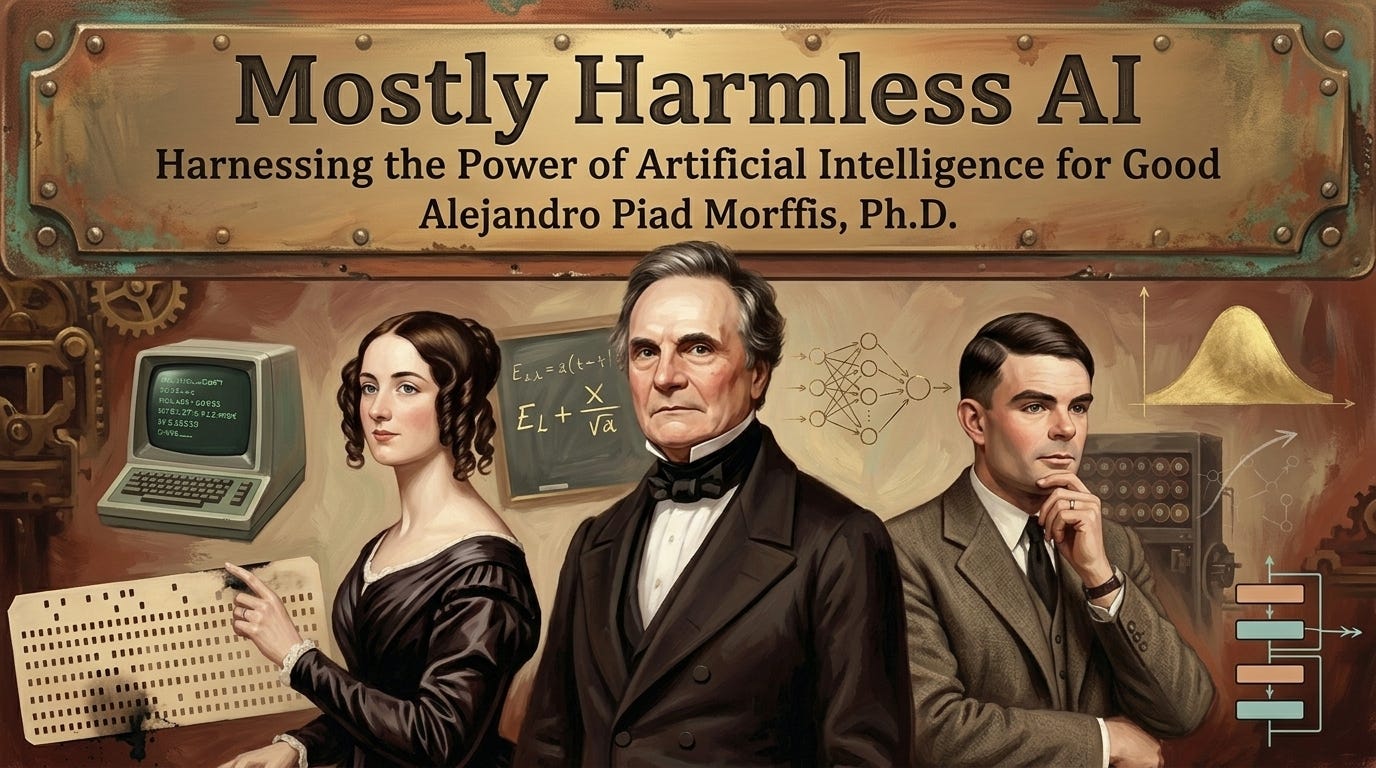
The first draft of Mostly Harmless AI, second edition, is done. Large parts of it are new. The first edition shipped in August 2025, and I think it was good — honestly. But it was also a 2024 book living in a 2026 world: it predated the reasoning models, the agentic turn, and most of what happened to AI through 2025 and into 2026, which is a lot.
I read it again a couple of months ago and realized the map was wrong. So I rewrote it. Fortunately, most of the structural work survived — the chapters are in roughly the same places, the argument is the same argument — but the content is substantially updated, and the agentic AI material especially has gone from a footnote to a full chapter. The goal has not changed: a model strong enough to update on whatever comes next.
What’s in it
The book has three parts. It leans heavily into large language models and agentic AI because that is what most people encounter today when they encounter AI. But it starts from the ground up — from the symbolic systems of the 1950s — and the through-line is seventy years of the same argument running in the same field.
Part I — Foundations explains how these things actually work, mechanism by mechanism. Six chapters: classical AI, machine learning, deep learning, language modeling, generative AI, agentic AI. The arc walks from symbolic reasoning to the agent loops running in 2026, and what the reader comes away with is the actual mechanism under the systems they talk to daily. Attention, gradient descent, RLHF — not the marketing line, the actual mechanism. If you have wondered what these terms mean, Part I is where you find out.
Part II — Applications is about how to use these systems, and how the fields most people care about are using them. Seven chapters: a working-with-AI orientation, then knowledge work, scientific research, software development, education and learning, creative work, and policy and governance. Each chapter is dual-audience: an expert in that field gets meaningful good-practice and real gotchas; a non-expert — a policymaker reading the policy chapter, a parent reading the education chapter — comes away with a clear picture of how AI is reshaping that field. No code, no tutorials, no ten prompts to make ChatGPT love you. Just an honest account of what these systems do well, what they do badly, and what changes when you put one in front of someone trying to get real work done.
Part III — Dangers is the hard part. Three chapters: alignment, the limits of language models, and the actual risks of AI. By actual I mean the harms that already exist in the world right now — deepfake fraud, autonomous-weapons concerns, biased decisions made at scale, workplace disruption — not the science-fiction extinction scenarios that collect most of the airtime. The existential-risk chapter is in there, but it sits inside a broader catalogue and gets the proportional treatment I believe it deserves. Part III is also where the book’s central position lands most clearly: the future is not predetermined. Neither doomer nor utopian framings are right. What we do about AI from here is a choice, and choices carry responsibilities.
Three parts. Sixteen chapters. Around two hundred and sixty pages of body prose. Almost three hundred footnote citations to peer-reviewed papers, technical reports, primary sources, news articles, and the occasional blog post that mattered. Every claim I could cite, I cited. Every claim I could not, I named as my own opinion. The full bibliography is at the back.
Who it’s for
Anyone who needs a working model of AI without necessarily writing code for it.
That is a wide audience, and I have tried to keep the prose accessible across all of it: knowledge workers thinking about how AI changes their jobs; educators thinking about how it changes their classrooms; policymakers thinking about how to regulate it without breaking it; parents thinking about what to tell their kids; entrepreneurs thinking about where the real opportunities are versus where the hype is; journalists, lawyers, doctors, executives, students of every stripe. The book assumes you are curious, reasonably literate, and not much else. The mathematics is very light if at all. The metaphors are tactile. The technical terms get defined the first time they appear.
Coders will find one chapter aimed directly at them — AI for Software Development in Part II — and they will find Part I interesting if they have not stopped to think about how the systems they use every day were trained. But this is not the book for coders. The book for coders is How to Train your Chatbot, the companion volume in the Computist Library. MHAI is the what is happening and why does it matter book; HTTYC is the how do I build this stuff book. Read Mostly Harmless AI first if you want the conceptual ground; jump to HTTYC if you are already comfortable with the concepts and want the engineering. Both are available in the Computist Library bundle if you want the pair at once.
That said — both books, all my books, everything I build — comes free to read online first. Which brings me to how this one works.
Why I made it
I have worked in AI for fifteen years and taught it for ten. I have been building AI-based tools for most of that time. What I have wanted to write for most of that period is a book that an intelligent reader — not an AI engineer, not a believer, not a doomer, just someone who needs to think clearly about what is happening — can read once and walk away with a model for what comes next. I did not have that book when ChatGPT launched. I did not have it when the agentic turn happened. I spent the last two years writing the version I wanted.
The short version of why that book matters: the AI conversation right now is dominated by two narratives that are both wrong. The first says AI will solve everything. The second says it will kill us. Most of the working reality is between them, and “between them” is not the same as “both extremes are partly right.” It is a third position, with its own shape and its own commitments. Mostly Harmless AI is my best attempt to lay that third position out clearly enough that you can argue with it.
Here is what the access model looks like, and what your support funds if you choose to give it.
Access and support
Mostly Harmless AI is free to read in perpetuity. Not a preview — the full book, all sixteen chapters, from chapter one to the bibliography — at books.apiad.net, in a reader I built specifically for these books. Clean typography. Dark mode that does not hurt. Footnotes that surface inline. No tracking, no required signup. This is how all my books work — and my open source, and these posts. The knowledge comes first. The access model is not a funnel.
Yes, asking you to pay for something that is also free is a slightly awkward pitch — I know. But here is the honest framing: the PDF and EPUB are on Gumroad for those who prefer to read offline or want to own a copy. Buying it is a gesture of support, not a paywall. The work is not free to make. The research, the rewriting, the next book — that is what your support actually funds.
Part of the proceeds from the second edition funds the Spanish translation of Mostly Harmless AI. That is a real thing I am working toward, and your purchase moves it forward.
And if you genuinely cannot pay: please, take it free. I would rather you have the knowledge than the gesture.
Where to find it now
The draft is at books.apiad.net right now, mostly readable as-is. The structure is settled, the prose is in place, and most chapters have been through at least one editing pass. The next two weeks are the final polishing phase — a full read for consistency, a copy edit for the sentences I have not caught yet, a few diagrams I want to redraw. The finished book ships on May 31. Gumroad for the PDF and EPUB, books.apiad.net for the free reader, both at once.
If you find something off while reading the draft, write to me. The May 31 edition will be better for it — and yes, I am aware of the mild absurdity of writing a book about AI while using AI to help write it. The ideas are all there. The 31st is just the cleaner version.
I genuinely enjoy reading everything published THE COMPUTIST JOURNAL. Beyond just the words, there's a clear and sincere purpose behind every sentence. And that motive for writing this book: 'I needed a book like this to hand to people who ask me what to read, and the book did not exist', is absolutely brilliant. It perfectly captures the 'if it doesn't exist, create it' sentiment, which is incredibly powerful. I'm really eager to dive into it.
The focus on explaining AI clearly instead of selling hype is what makes this worth reading