


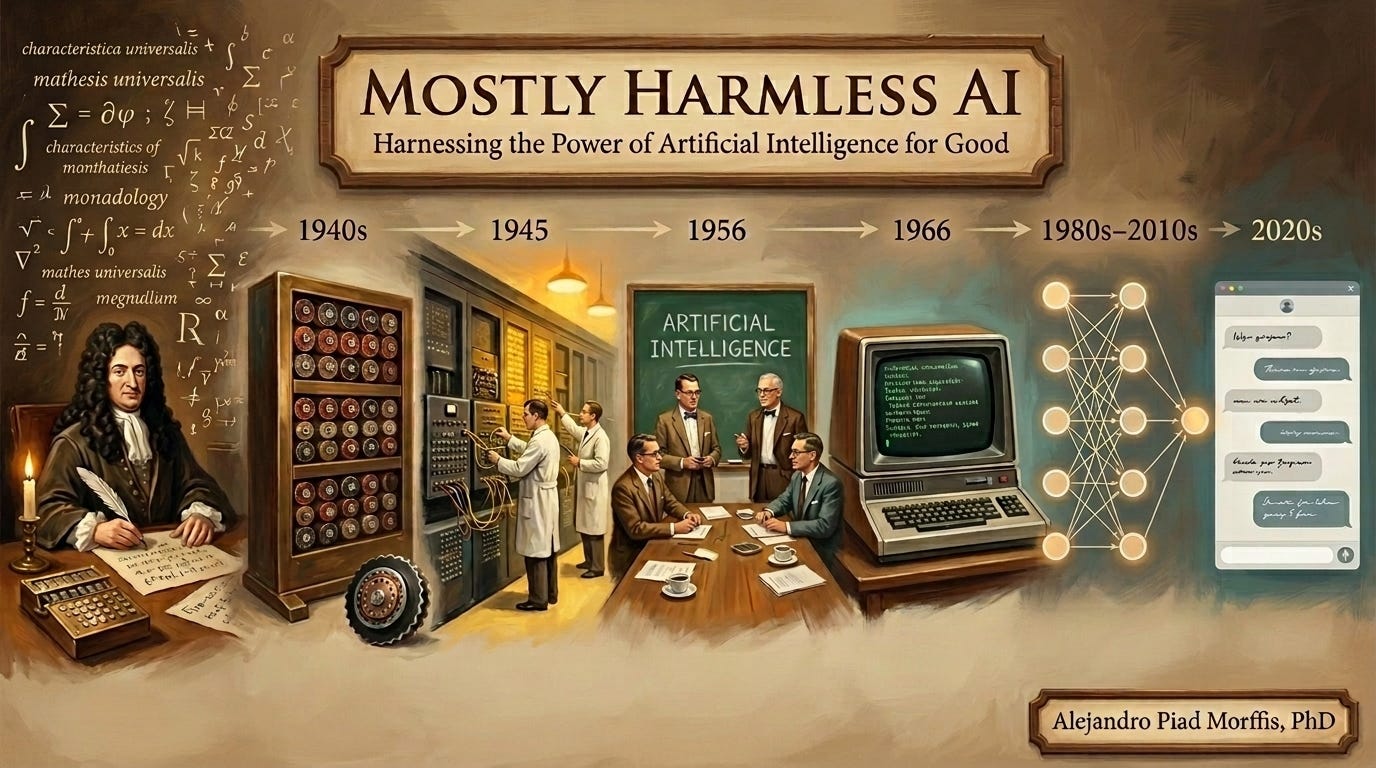
Hey! Happy Sunday. Here is a quick note to remind you that Mostly Harmless AI, second edition, draft one, is finished. PDF and EPUB on Gumroad. Free online reader at books.apiad.net. Both live, right now.
This book is a permanent beta, because the AI story is being created as I write these words and it’s moving just too damn fast for anyone to put it down cleanly in a book. So don’t expect the kind of polishing that comes with retrospective looks at settled topics. This isn’t that kind of book. It’s raw, but up-to-date. It contains basically everything I know and believe about AI that doesn’t require code or math to understand it.
Sixteen chapters, mechanism-first
Three parts, sixteen chapters, around two hundred and sixty pages, almost three hundred footnote citations.
Part I — Foundations walks the mechanisms, from the symbolic systems of the 1950s to the agent loops of 2026. Classical AI, machine learning, deep learning, language modeling, generative AI, agentic AI. If you have ever wondered what attention, gradient descent, or RLHF actually mean (not the marketing line, the mechanism), start here.
Part II — Applications shows how AI is reshaping each field: knowledge work, scientific research, software development, education, creative work, policy. Dual-audience throughout. Experts get practice and gotchas. Non-experts see why their lawyer, their doctor, and their kid’s teacher are suddenly using these tools.
Part III — Dangers is the honest one. Alignment, the limits of language models, and the harms already in the world today: scammers cloning your mother’s voice, autonomous weapons that pick their own targets, hiring algorithms that quietly downrank you, jobs evaporating from under people who built careers in them. The existential-risk question is in there too, treated proportionally.
The book lands on a third position beyond maximalists and doomerists. These systems are powerful enough to demand real responsibility and limited enough that the worry should be about who deploys them, not about the silicon waking up. The future is not predetermined. Neither doomer nor utopian framings are right. We choose, and choices have responsibilities attached.
The first-draft post from two weeks ago has the longer description if you want more.
Free online, or pay for offline
Read it free online, in perpetuity, at books.apiad.net. Clean typography, gentle dark mode, inline footnotes. No popups, no signup, no tracking. The reader was built for these books specifically.
PDF and EPUB on Gumroad if you want it offline, on your e-reader, on a plane: apiad.gumroad.com/l/ai. Launch week is 50% off.
If the online reader is free, then why would you buy it? Well, you don’t have to. But here is why you may want to do it anyway.
Writing this book took two years. The second edition took three months of intense rewriting on top of that. If you find value in the work and want more of it to exist (these books, the Computist Library, the journal you are reading), paying for the PDF is how you tell me that. I do not run ads. I do not sell your attention. Every book sale is one person telling me to keep going, and the money buys the months it takes to write the next one.
If you cannot pay, read it free. No guilt, no caveat. That option exists on purpose.
June is algorithms month
After today, I am putting AI writing to sleep for a couple of months, on purpose.
Not the work — I will still be building AI tools and using these systems every day. But on this journal, starting tomorrow and through July, I am switching to algorithms and core computer science, with The Algorithm Codex as the spine. The Codex is the next book in the Computist Library, written in parallel with MHAI and ready for center stage. Already 200 or so pages, and 50+ algorithms in, but still very rough around the edges, in dire need of your feedback.
During June, you can expect daily posts, Monday through Friday, each anchored on a chapter. Why the fastest algorithm ever devised runs in essentially constant time. Why most programmers get binary search wrong. Why no comparison sort can beat n log n, and the loophole that lets you anyway. Why some algorithms become settled facts the way theorems do.
AI returns to the journal in August. The field will surely have moved a lot by then, and there will be more than a few chapters to retouch.
So if you come here for the AI material, this book is the most complete thing I have on it — go read that. If you have been curious about the algorithms side, the next two months will be the best stretch of it I publish all year.
That’s all for today. Tomorrow I’ll meet you again with a brand new article.
Until then, stay curious.